
Views: 0 Author: Site Editor Publish Time: 2026-07-03 Origin: Site


Many amateur players hesitate to upgrade their billiard cues for one simple reason: both entry-level house cues and premium pro cues can strike the cue ball. The performance gap feels vague and subjective at first glance. This confusion is completely understandable.
Nevertheless, the core advantages of high-grade billiard cues lie in hidden structural details rather than superficial decorations. Strict manufacturing tolerances deliver stable hitting feedback and long service life. Top cue manufacturers do not merely add decorative elements to raise pricing; they restructure energy transmission paths from your grip to every shot.
This article breaks down all pivotal micro-components of professional billiard cues, covering joint fitting tolerance, ferrule weight optimization, shaft taper design and more. We elaborate on the key differences between mass-produced cues and investment-grade professional models, equipping players with systematic structural knowledge to judge real premium quality when upgrading their cues.
a. Premium hitting hand feel originates from precise mechanical alignment: seamless joint assembly and customized pin threading control vibration transmission during impact.
b. Lightweight front-end structure and accurate taper profiles (solid maple, spliced wood or carbon fiber) are the core factors lowering cue ball squirt (deflection).
c. Solid natural wood inlays and seamless grip wraps represent rigorous production standards, effectively avoiding deformation, bulging and loosening after long-term use.
d. To judge a high-quality billiard cue accurately, distinguish flashy cosmetic marketing from practical structural performance and tactile experience.
Most mass-market cues deliver unstable hitting feedback, accompanied by obvious buzzing vibration or dull, lifeless impact feeling. These annoying defects stem from tiny gaps between shaft collars and cue butts. Kinetic energy leaks through micro clearances when striking balls, which premium billiard cues fully eliminate through seamless joint design for perfect mechanical alignment.
We analyze vibration conduction based on three core joint components:
Different metal pins adjust the cue’s balance point distinctly:
Steel pins: High density adds rear weight and shifts balance backward;
Brass pins: Classic neutral weight option with moderate hand feel;
Titanium / G10 fiberglass pins: Ultra-lightweight to reduce front-rear center mass, creating forward-biased balance suitable for soft stroke control.
Choose pin material according to your habitual stroke rhythm and balance preference.
Main mainstream thread standards include Radial Pin, Uni-Loc Quick Release and Standard Thread. Thread type cannot directly boost shooting accuracy but determines assembly efficiency and locking tightness: quick-release threads realize fast disassembly; radial pins feature deeper locking fit for tighter integration with wood core.
Carefully check the phenolic resin or stainless steel joint collar surface—top-tier cues adopt fully flush seamless fitting. Use the fingernail test as a simple inspection standard: slide your fingernail over the assembled joint seam; no friction or catching texture should be felt. Zero gap transition is the direct symbol of high-precision machining.
One critical reminder for joint selection: proprietary customized joint structures limit compatibility with third-party aftermarket shafts, locking you into a single brand’s accessory ecosystem. Players need to trade off structural performance advantages against later upgrade flexibility.
The shaft is the performance core of a billiard cue. Three mainstream shaft materials dominate the market: solid maple log, spliced composite wood and carbon fiber composite. Each material generates unique cue ball motion and hand feel upon impact. We evaluate shaft performance from two dimensions:
Shaft outer diameter contour decides stroke stability:
Pro Taper: Maintains uniform diameter for 12–14 inches forward from the tip;
European Taper: Gradually thickens from the tip backward. Premium shafts maintain ultra-stable dimensional accuracy, keeping consistent thickness across the entire bridge sliding area to avoid hitting deviation caused by uneven tapers.
High-end cues adopt hollow ferrules, lightweight fillers and optimized inner core structures to cut front-end mass, minimizing cue ball deflection (commonly known as "squirt"). Less squirt means players require less aiming compensation for side spin shots.
Shaft Material | Deflection Level | Tactile Resonance | Durability & Anti-Warp Performance |
Solid Natural Maple | Medium-High | Strong classic wood vibration feedback | Standard; needs regular humidity maintenance to prevent warping |
Spliced Composite Wood | Low | Moderate soft resonance | Excellent; strong anti-deformation capability |
Carbon Fiber Composite | Ultra-Low | Muted, soft hitting feedback | Top level; fully resistant to warping under extreme temperature & humidity |
Note on carbon fiber shafts: Carbon fiber boasts outstanding durability and zero warping risk, yet its dampened vibration requires an adaptation cycle for players accustomed to warm wood resonance. Users need to adjust shot power control habits for stable performance.
Single-layer leather tips suffer uneven compression under frequent heavy hitting, prone to chalk loss and frequent trimming maintenance. Multi-layer compressed pigskin tips have become the mainstream configuration for professional cues due to stable, predictable hitting feedback on every shot.
Three premium tip manufacturing standards to identify high-quality cues:
Top-grade tips adopt 8–11 layers of compacted pigskin, with Kamui, Predator and Zan as globally recognized benchmark brands. Multi-layer compression avoids sudden collapse and deformation under high-intensity impact.
Tip hardness directly controls energy transfer efficiency and contact dwell time on cue balls:
Soft tips: Longer ball contact time for strong spin generation, higher maintenance frequency;
Medium tips: Universal standard choice for most amateur and pro players;
Hard tips: Maximum energy transmission, minimal mushroom deformation during long-term use.
Factory fitting quality determines tip service life: premium cues polish tips to perfectly fit ferrule flat surfaces, with meticulously burnished edges to lock out moisture, slow mushrooming and extend leather service life.
Uneven glue joints with tiny air pockets between tip and ferrule severely reduce spin output. Reputable manufacturers spend extra polishing time to create fully seamless bonding at this critical contact point.
Hand sweat and moisture directly destroy grip stability during long matches. Premium billiard cues adopt targeted wrapping materials to isolate sweat interference, assessed by moisture absorption and anti-slip friction:
High-standard linen wrapping undergoes heavy compression and surface polishing, forming smooth textured wood-like touch with zero gaps between linen threads, excellent sweat absorption for sweaty palms.
Low-quality leather peels and warps in humid environments, while premium leather adopts skived seamless splicing—joint edges feel smooth without protruding seams. It never lifts or curls under continuous sweaty gripping during long games.
Many pro players prefer bare wood grip without wrapping. High-end cue butts apply UV cured surface coating, resisting scratches and chipping from accidental drops. In contrast, premium shafts abandon full paint coating, treated with micro-sealant only to eliminate sticky friction during bridge sliding.
Wrap selection suggestions: Sweaty-handed players suit compressed Irish linen; players pursuing locked firm grip choose textured genuine leather. The precision of wrapping construction weighs far more than raw material categories.
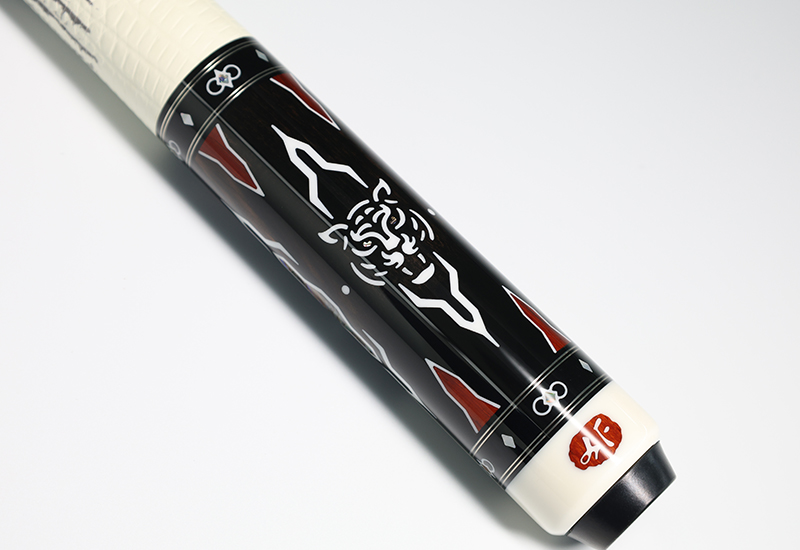
Decorative details reflect a brand’s manufacturing standards. Mass-produced cues rely on water transfer printed decals simulating luxury texture, while professional investment-grade cues adopt CNC carved exotic solid wood inlays. Two simple identification methods:
Visual inspection: Real wood inlays carry clear, natural grain dividing lines (e.g., ebony embedded in bird’s eye maple). Printed decals reveal faint dot matrix texture under light, covered by thick unified clear paint hiding inferior base wood.
Hand touch test: Genuine abalone shell, turquoise or metal inlays are milled to micron-level tolerance. Running fingers over the forearm surface should feel a continuous whole without raised or sunken transition gaps between inlay and base wood.
Important objective note: Inlays deliver zero improvement to hitting performance or deflection control. They act only as a craftsmanship benchmark, reflecting the precise labor input and strict tolerance control during production.
Avoid blind pursuit of brand marketing gimmicks when upgrading cues; follow this structured screening process focusing on practical hitting performance:
Confirm balance point preference first: Decide whether you need forward-biased light balance or rear-heavy pendulum swing based on your natural stroke habit, instead of picking brands blindly.
Prioritize front-end investment: Allocate most of your budget to shaft and tip accessories—front-end components directly affect ball motion physics; cue butts mainly function as weight adjustment carriers.
On-site hitting test whenever possible: Execute powerful stop shots and forceful follow shots to detect abnormal vibration transmitting to your grip hand. Qualified premium cues deliver solid, compact impact without buzzing.
Self-assessment before purchase:
If you frequently apply heavy side spin (English): Prioritize low-deflection carbon fiber shafts;
If you pursue delicate power control and natural wood resonance: Select high-grade spliced maple shafts. Match cue configuration to your personal playing style for optimal experience.
A truly premium billiard cue is defined by micron-level precision in every component. Flawless joint fitting, standardized layered tip processing and targeted weight distribution eliminate unstable hitting variables that ruin consistent gameplay.
High-end cues cannot fix flawed basic stroke mechanics—proper stance, alignment and straight swing remain fundamental. However, professional-grade structural design removes equipment interference, letting players focus purely on shot execution without distraction from defective cue performance.
Check joint collars for fully seamless, zero-gap fitting;
Prioritize shaft front-end technology over complex decorative butt inlays;
Select tip hardness based on your acceptable maintenance frequency;
Match wrap material to local environmental humidity and personal palm sweat level.
A: Yes. Shaft structural design determines deflection performance. Lightweight hollow ferrules and thin front-end structures cut front mass to lower squirt; cue butts barely influence this indicator. Deflection control relies entirely on front shaft configuration.
A: Carbon fiber gains absolute advantages in durability and anti-warp performance, maintaining consistent specs long-term. However, overall superiority remains subjective. Numerous professional players favor the unique warm resonance and hitting sound of natural wood shafts.
A: Service life depends on playing frequency and tip hardness. Regular players replace tips every 6–12 months. Proper edge burnishing seals moisture and delays mushroom deformation to greatly extend service cycles.
A: It is feasible under one prerequisite: the joint pin thread standard and collar diameter must be fully matched. This solution delivers obvious performance improvement without purchasing an entire brand-new cue set, highly cost-effective for performance upgrades.


